
How Do Insurance Deductibles Actually Work?
By: Hayley Rodriguez, Personal Lines – Sales Executive
If you’ve ever looked at your insurance policy and wondered, “How much am I actually going to have to pay if I file a claim?”, you’re not alone. Insurance is full of confusing terms and jargon, making it difficult to understand exactly what you need to know.
However, your deductible can have a big impact on what you pay out of pocket after an accident… and choosing the wrong deductible can leave you scrambling for cash when you need your insurance most. It’s an uncomfortable place to be in.
At Grimes Insurance Agency, we’ve helped clients understand the basics (including deductibles) behind their insurance policy since 1948. We want policyholders to be educated and confident when it comes to all things coverage.
In this article specifically, we’ll break down:
- How insurance deductibles work
- How they affect your premium
- How to choose a deductible that fits your situation
What is an insurance deductible?
An insurance deductible is the amount of money you agree to pay out of pocket before your insurance company pays its portion of a covered claim.
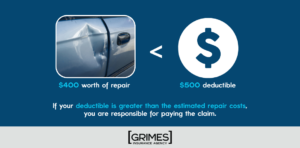
For example, if you ding your car door and the repair costs $400, but your deductible is $500, you’d pay for the entire repair yourself.
Why do insurance companies have deductibles?
A deductible isn’t simply your “share” of an insurance claim. It’s also a way for insurance companies to limit small claims and keep insurance focused on larger losses.
Think about that $400 car-door repair. If your deductible is $500, there’s no reason to file a claim because you’re responsible for the full cost anyway.
That means you’re more likely to handle smaller repairs yourself, rather than putting every minor ding, scrape, or repair through your insurance. Your deductible creates a line between expenses you can reasonably handle yourself and losses where you need your insurance coverage to step in.
This is important because your claims history can affect your insurance costs, risk profile, and how insurers view your policy options. Point blank: your deductible can make or break your insurance process.
Did you know insurance carriers can see every claim you’ve made in the past seven years? Read How is Insurance Risk Calculated to learn how insurers review your claims history and how it can affect your insurance premiums.
Does a higher deductible really lower your insurance premium?
Generally, yes. The formula typically goes this way:
- A higher deductible = a lower premium
- A lower deductible = a higher premium
Raising your deductible will typically reduce your premium. Let’s bring back the car door example to watch the math.
Higher deductible = lower premium

Because your deductible was higher than the repair cost, you are absorbing more of the financial risk instead of your insurance company. In turn, your insurance company lowers your premium since you shoulder the most risk.
Lower deductible = higher premium

Because your deductible was lower than the repair cost, your insurance company shoulders the cost. This generally means your carrier will expect to pay more small claims, so it will charge you a higher premium to cover that exposure.
The relationship between deductible and premium
However, at the end of the day, keep in mind: the difference from raising or reducing your deductible isn’t always astronomical. In most cases, you’re looking at relatively modest monthly savings.
That’s why it’s worth asking your insurance agent to show you the actual numbers before you increase your deductible.
If raising your deductible saves you only a few dollars a month, you should consider whether those savings are worth taking on an additional $500 or so of financial responsibility when you have a claim.
Don’t choose a higher deductible based on the assumption that the premium savings will be significant. Look at the actual numbers for your policy.
How do you choose the right insurance deductible?
Instead of starting with the premium, start with your bank account.
Ask yourself one question:
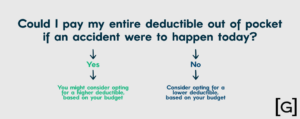
If I had a covered loss tomorrow, could I comfortably pay my entire deductible without putting my finances under serious strain?
- If you answered no, then your best option is to go with a lower deductible
- If yes, a higher deductible might suit your needs best.
For example, if a $1,000 deductible would force you to put the expense on a credit card, sell something, or scramble to find the money, that’s an important warning sign.
A West Texas example
That’s especially important here in West Texas, because wind and hail deductibles usually aren’t a flat dollar amount. Instead, they’re a percentage of your home’s insured value, commonly 2%. On a $300,000 home, that’s a $6,000 deductible if hail damages your roof. It’s worth doing that math before a storm hits, not after. And we all know that West Texas storms can often come without warning.
One of our own Grimes members learned this firsthand when a Lubbock hailstorm sent hail straight through her bedroom window, tore holes in her siding, and knocked her patio door off its frame. Because it took time for an adjuster to assess the damage, her windows stayed boarded up for months.
Storms like that aren’t rare here, and roofs bear the brunt of it. Texas home roofs often age faster due to severe weather and heat. That’s why it’s worth thinking through your deductible before a storm and not during one. If a percentage-based deductible would catch you off guard, talk to your agent about whether a different deductible, or a higher savings cushion, makes more sense for you.
The right deductible isn’t necessarily the lowest or highest number. It’s the amount you can realistically afford when something goes wrong. Your deductible should reflect your financial situation, not what someone else is comfortable paying.
Curious if your policy is measuring up and protecting you where it matters? Read How to Tell if You’re Uninsured to learn where coverage gaps can happen.
Are insurance deductibles different for home, auto, and life insurance?
Depending on the type of insurance policy you have, your deductibles can work differently. Let’s break them down:
| Deductible Available? | What you should know | |
| Auto Insurance | Yes | Comprehensive and collision coverages have separate deductibles |
| Home Insurance | Yes | Wind, hail, or other claims may have different deductibles |
| Life Insurance | No | The beneficiary files a claim and receives the benefit according to the policy terms |
The takeaway: don’t assume every policy uses the same deductible. Before you file a claim, check your policy to see which deductible applies to which type of loss.
Curious how different types of insurance policies actually compare? Read Auto, Home, and Life Insurance Basics to learn how auto, home, and life insurance work and what they cover.
Grimes Insurance Can Help You Determine the Right Deductible
At the end of the day, the right deductible is the amount you could afford to pay out of pocket without creating a financial crisis.
- A higher deductible may lower your premium, but you’re taking on more financial responsibility if you have a claim.
- A lower deductible generally means paying more for your insurance, but you won’t have to come up with as much money after a covered loss.
Either option can be beneficial, but it all depends on your financial situation and comfort level.
Insurance is ultimately about managing financial risk. Your deductible is one of the biggest decisions you can make about how much of that risk you’re willing and able to handle yourself.
Before changing your deductible, ask your insurance agent to show you the actual premium difference. Then compare those savings with the additional amount you’d have to pay if you had a claim. That calculation can make all the difference for your deductible decision.
Now that you understand how deductibles affect what you pay after a claim, the next step is understanding whether your policy provides enough protection in the first place. Learn How to Tell if You’re Underinsured and which places coverage gaps can happen most often.
Or, if you’re interested in discussing your policy’s deductibles, contact our office to connect with an agent. At Grimes Insurance Agency, we value educating clients on the insurance basics, helping them feel confident about their policy’s terms and definitions.


