
What Causes Home Insurance Rates to Increase?
Quick Answer:
Home insurance rates can increase because of your home’s claims history, your own claims, roof age and condition, property inspections, location, and other risk factors. Rates can also increase because of losses across the broader insurance market, including the cost of widespread hail and wind damage in West Texas. While you can’t control every factor affecting your premium, understanding what’s driving your increase can help you decide what to do about it.
You opened your homeowners insurance renewal expecting a similar rate to last year, but instead… you’re met with a bill increase. Confusion and questions flood your mind:
Why did my rates increase? What can I do about this? And WHY is this so frustrating?!
They’re questions we hear all of the time. The answer is that insurance premiums are affected by many different factors. Some are connected to the choices you make, and others are simply outside of your control.
For over 78 years, Grimes Insurance Agency has helped West Texas homeowners understand their insurance coverage. While every client’s situation is different, we regularly help homeowners identify why their premiums changed and what options they have moving forward.
By the end of this article, you’ll understand:
- What causes home insurance rates to increase
- What factors you can control
- What steps you can take to ensure your coverage still fits your needs
Why Did My Home Insurance Rates Increase?
There are two broad reasons your home insurance premium can increase:
- Factors specific to your home
- Factors affecting the surrounding insurance market
Let’s break them both down together.
What Personal Factors Increase My Home Insurance Rates?
Contrary to what many policyholders believe, insurance is hardly a “set it and forget it” type of purchase. It’s an item that’s meant to grow with you as you and your assets change– in both protection and (sometimes) price. This means that some rate increases are connected directly to your home or insurance history.
What Home Changes Can Increase Insurance Rates
Has your home changed in the last year? Have you made any home improvements or additions? Has your home’s condition aged significantly?
If yes, it’s a likely reason for a premium increase. As your home changes and ages, your coverage and pricing may too. Rates can be affected by property factors such as:
- Adding features (pools, trampolines, etc.)
- Making high-value home upgrades
- Roof age and condition
For many of our clients, an aging roof has been one of the biggest premium increase surprises.
We recently worked with a homeowner whose roof was nearing ten years old. He hadn’t filed any claims and assumed his rate would remain steady. However, once his roof crossed that age threshold, his carrier began applying a depreciation schedule to any future roof claim. That meant less payout (and more out of his pocket) if hail or wind damage hit. It wasn’t something he’d thought about until his premium jumped at renewal.
How does my roof’s age and condition affect my insurance rate?
Let’s break down why roof age even matters in the first place.
Your roof is one of the most important parts of your home, but easily forgotten about. As your roof ages, your insurance risk increases as well. Insurance risk is the probability of a loss happening and how much it would potentially cost.
Older roofs typically have a greater number of insurance claims than newer roofs. While the range varies between carriers (and what your roof is made of), insurers begin to raise home insurance rates once your roof reaches 15-20 years old.
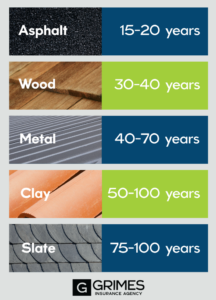
Various Roof Material Lifespans
Keeping your roof (and home’s) information in mind can help prepare you for premium surprises. We recommend recording details about your roof’s age, condition, and repairs as helpful documentation for such scenarios, and to discuss them with your insurance agent.
Interested in learning more about the role insurance risk plays in coverage? Read about how insurance risk is calculated.
Can Filing an Insurance Claim Increase My Home Insurance Rates?
How come something that’s meant to protect you costs more when you use it? It sounds backwards; we know. However, it’s simply the way insurance works.
Your premiums can be directly affected by your insurance claims, even small ones. Insurers rely on your claims history to determine (you guessed it!) your risk profile.
It can be tempting to file a claim whenever your damage exceeds your deductible. But the cost of a claim isn’t necessarily limited to the difference between the two.
Consider this example: your deductible is $500, and you have $600 in covered home damage. Filing a claim may seem like an obvious decision because you’re only $100 above your deductible.
However, a claim can become part of your insurance history and may affect how an insurer evaluates your risk in the future, and a heavy claims history can increase your rates. That’s why it’s worth looking beyond the immediate payout.
Before filing a small claim, ask your agent to help you understand the potential long-term impact– not only what you’ll receive after your deductible. The right decision can depend on the circumstances, your policy, the size of the loss, and how your insurer evaluates claims history.
What is a claims history?
A surprise for homeowners is that, like people, properties also have a claims history. A property’s previous claims history can affect how insurers view the home, even if you weren’t the homeowner who filed the claim.
For example, let’s say the homeowner you recently purchased your home from experienced a burst pipe in the kitchen. After the incident, they filed a water damage claim. Despite you not living there when it occurred, that history is still associated with the property and could affect how an insurer evaluates the risk.
How do I learn about my home’s claim history?
If you’re buying a home, ask about the property’s insurance history before you close so you can understand what claims history may follow the address. This information is filed in a document called a CLUE (Comprehensive Loss Underwriting Exchange) report. Insurers use your CLUE report to price your home insurance policy and evaluate your insurance risk.
To review your home’s claim history, you can request and dispute your CLUE report once a year through the Lexis Nexis Consumer Portal. If your report seems concerning, we recommend walking through your information with an insurance agent. Doing so can help you prevent surprises and make it easier to understand your options more accurately.
What External Factors Affect My Home Insurance Rates?
Not every rate increase has to do with your home specifically. A lot of it comes down to what’s happening across the insurance market as a whole.
Can Home Insurance Rates Increase Even if I’ve Never Filed a Claim?
Unfortunately, yes. Insurance works by pooling risk, which means everyone’s premiums go into a shared pool that covers the claims paid out across all policyholders, not just yours.
When claims and losses go up in your area, or across an insurance carrier’s book of business, rates tend to rise for everyone in that pool– even for homeowners who’ve never filed a claim.
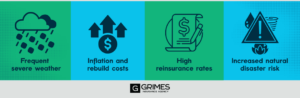
Additional external factors that can increase your home insurance rates include:
- Frequent severe weather (aka, West Texas hail, dust, and ice storms)
- Inflation and rising rebuild costs (higher material and labor expenses = higher insurance rates)
- Higher reinsurance prices
- Increased natural disaster risk
If you’re worried about how external factors may affect you and your coverage, talk with a Grimes Insurance agent. We’re happy to help walk you through your coverage, answer your questions, and discuss how to be prepared for the unexpected.
What Can I Do When My Home Insurance Rates Increase?
You can’t control every factor affecting your premium. You can’t prevent every hailstorm or control the number of losses your insurance carrier experiences.
But you can take steps to understand and potentially prevent some of the factors affecting your premium.

1. Keep your roof and property in good condition
Maintain your roof, siding, fencing, trees, and other structures. Regularly document changes and repairs.
2. Think carefully before filing a small claim
If the damage is only slightly above your deductible, talk to your agent before filing. Ask about the potential long-term impact, because paying out of pocket may save you more in the long run.
3. Ask about your deductible options
A higher deductible can lower your premium, but it also means you’ll pay more out of pocket when you have a covered loss.
Choosing a deductible is a trade-off between what you pay today and what you can comfortably afford after a claim.
Talk with your agent about your options based on your financial situation and risk tolerance.
4. Have an agent review your renewal
When your renewal increases unexpectedly, don’t assume there’s nothing you can do.
An agent who understands your policy can help identify what changes, explain coverage, and help determine whether there are adjustments (or discounts) worth considering.
How Can Grimes Insurance Help Manage My Coverage?
Despite its confusing nature, a home insurance rate increase doesn’t always mean you did something wrong or that you need to immediately switch policies. Your premium can change based on factors related to your home, your claims history, or broader changes in the insurance market.
If your renewal is higher than expected, start by finding out why your premium changed. Review your renewal, consider changes to your home or claims history, and talk with your agent about your coverage and available options.
Understanding what’s driving the increase can help you make a more informed decision about your policy. At Grimes Insurance Agency, we are dedicated to helping West Texas homeowners understand their coverage and navigate changes to their policy. You’ll not only have help understanding your coverage, but also managing it throughout your policy. With the help of our retention team, you’ll always have someone in your corner to ensure your policy is protecting you where it matters most.
Wondering whether your new premium is reasonable? Learn more about Home Insurance Costs in Lubbock to understand what factors influence costs in the Lubbock area and what you may expect to pay.


