
Insured vs. Uninsured vs. Underinsured: What’s the Difference?
By: Hayley Rodriguez, Personal Lines – Sales Executive
Executive Summary
Having auto insurance doesn’t always mean you’re fully protected. An insured driver has coverage, an uninsured driver has none, and an underinsured driver doesn’t have enough to cover the full cost of an accident.
You could have insurance and still be financially responsible if another driver doesn’t have enough coverage. That’s where uninsured/underinsured motorist (UM/UIM) coverage can help protect you from the resulting financial gap.
You have auto insurance. You pay your monthly premium. You should be protected in an accident, right?
Unfortunately, not always. Having insurance doesn’t always mean having enough insurance. If the driver who causes an accident has no insurance or doesn’t have enough coverage to pay for the damage they cause, you could be left dealing with the difference. And trying to understand where your coverage falls is an uncomfortable place to be in.
At Grimes Insurance Agency, we’ve helped West Texas drivers understand their auto insurance coverage since 1948. We believe policyholders should feel educated and confident about what their insurance actually protects.
In this article, we’ll break down:
- What it means to be insured, uninsured, or underinsured
- How uninsured/underinsured motorist coverage can help
- What happens if you’re involved in an accident with an uninsured or underinsured driver
- What to look for when reviewing your own auto insurance policy
What does it mean to be insured, uninsured, or underinsured?
The simplest way to understand the difference:
| Situation | What it means |
| Insured | The driver has an active auto insurance policy. |
| Uninsured | The driver has no active auto insurance. |
| Underinsured | The driver has insurance, but not enough to cover the full cost of the accident. |
The common thread all three terms have in common is liability insurance.
What is liability insurance?
Liability coverage is what helps pay for injuries or property damage you cause to someone else in an accident, up to your policy limits.
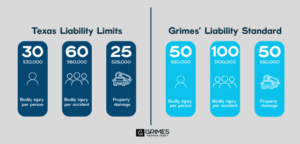
Most states require drivers to carry a minimum amount of liability insurance. In Texas, minimum liability limits are written as 30/60/25. This includes:
- $30,000 per person for bodily injury
- $60,000 per accident for bodily injury
- $25,000 per accident for property damage
However, keep in mind that carrying the legal minimum and carrying enough coverage for your situation are two different things. That’s where the difference between being insured and being adequately insured becomes important. Let’s break down what these coverage levels can look like.
What does it mean to be an insured driver in Texas?
Being insured means you have an active auto policy that meets at least Texas’ legal requirements.
You can also add other coverages to your policy, such as collision and comprehensive coverage, depending on the protection you want and the requirements of your lender.
It’s important to remember that not all coverages are the same. Read What Does Full Coverage Car Insurance Actually Include? to learn which coverages you should consider adding to your policy.
What does it mean to be an uninsured driver?
An uninsured driver is someone who doesn’t have active auto insurance coverage.
If an uninsured driver causes an accident, there is no liability insurance policy available to pay for the damages they’re responsible for. In theory, the driver may be personally responsible for those costs. In practice, however, collecting from someone who doesn’t have insurance can be difficult.
Unfortunately, uninsured drivers aren’t rare. As of 2025, 11.87 percent of Texas drivers are uninsured. If approximately 1 in 8 Texas drivers are uninsured, that’s a real risk drivers should be aware of when considering their own protection.
But there’s another side to this problem: you don’t want to be the uninsured driver.
Maintaining the required auto insurance coverage is the first step. Letting a policy lapse, cancelling coverage without replacing it, or driving without the required insurance can leave you personally responsible for damages you cause.
If you’re currently uninsured and looking for coverage, Grimes Insurance Agency can help you search. Call our office to discuss the coverage you need and how you can find it.
What does it mean to be an underinsured driver?
An underinsured driver is different from an uninsured driver. An uninsured driver has no insurance. An underinsured driver has insurance, but their liability limits aren’t high enough to cover the full cost of an accident they cause.
Let’s consider an example.
Imagine you’re driving down Marsha Sharp Freeway when another driver merges and collides with your vehicle. The other driver is at fault, and the damage they caused to you and your vehicle is over $80,000. However, the driver is underinsured and only carries the Texas minimum liability limits. Covering only $50,000 of what they owe, you and your insurance company are left to cover the remaining cost.
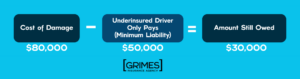
That’s the coverage gap created by an underinsured driver.
And there’s a similar concern when you’re looking at your own policy: you don’t want to discover that your liability limits are too low after you’ve already caused a serious accident.
How do you know if you’re an underinsured driver?
Being underinsured isn’t always obvious. You may have an active policy, pay your premium every month, and still carry limits that don’t provide as much protection as you need.
Some questions to ask when reviewing your policy include:
- What are my current liability limits?
- Would those limits be enough to protect my assets if I caused an accident?
- Have my financial circumstances changed since I chose my coverage?
- When was the last time I reviewed my policy?
At Grimes, we typically recommend 50/100/50 coverage as a starting point for many clients, rather than automatically defaulting to Texas’ minimum liability limits. The appropriate coverage can vary depending on your circumstances, which is why reviewing your policy matters.
Worried you might be an underinsured driver? Read How to Tell if You’re Underinsured and learn what to keep in mind when purchasing your coverage.
What happens if an uninsured or underinsured driver hits you?
So far, we’ve looked at how to make sure you aren’t uninsured or underinsured.
But what happens when the other driver is?
If an uninsured driver causes an accident, there may be no liability insurance available to compensate you for covered losses. You may have to pursue the driver personally, which can be difficult if they don’t have the financial resources to pay.
If the other driver is underinsured, their insurance may pay up to its applicable limit, but that limit may not be enough to pay for all of your covered losses.
That’s where uninsured/underinsured motorist (UM/UIM) coverage can help.
UM/UIM coverage is designed to provide financial protection in the case of an accident involving a driver lacking enough coverage or with no coverage at all. It is a separate type of coverage that can be added to your existing auto policy.
Worried about an uninsured driver hitting you? Watch this video to learn what you can do if you are involved in such an accident:
In Texas, auto insurance companies are legally required to offer you UM/UIM coverage. If you decide to opt out of UM/UIM coverage, you are required to reject it in writing when finalizing your policy details.
The important thing to remember is that UM/UIM coverage addresses a different problem than your own liability coverage. Your liability coverage helps protect you when you cause an accident. UM/UIM coverage can help protect you when the at-fault driver doesn’t have enough coverage.
The difference between what the other driver’s policy pays and what you’re actually owed is the coverage gap. And that gap is where underinsured motorist coverage can be a lifesaver.
Grimes can help you be properly insured
Insurance shouldn’t be a guessing game. You don’t have to wait for an accident to find out if you have enough coverage.
By reviewing your liability limits, confirming your policy is active, and checking your UM/UIM coverage, you can get a clearer picture of how well you’re protected and where potential gaps may exist.
Now that you understand the differences between being insured, underinsured, and uninsured, your next step may be to understand when minimum coverage makes sense for you. Read Is Minimum Car Insurance Ever Enough? to learn how much coverage is enough for your auto situation.
Or, if you’re unsure what your policy means and want help with your coverage, feel free to tel:806-762-0544 to talk with an insurance professional. At Grimes Insurance Agency, we’ve been helping West Texas drivers understand their auto insurance coverage since 1948. We’ll connect you with an agent who can help you understand what you’re carrying and where potential gaps may exist.
Frequently Asked Questions
What’s the difference between uninsured and underinsured?
An uninsured driver has no active auto insurance. An underinsured driver has insurance, but their liability limits aren’t enough to cover the full cost of an accident they cause.
Is UM/UIM coverage required in Texas?
Texas insurers are generally required to offer UM/UIM coverage, and drivers can reject the coverage in writing.
How much auto insurance coverage should I carry?
There isn’t one coverage amount that makes sense for every driver. Your appropriate limits can depend on factors such as your assets, financial circumstances, vehicle, and risk tolerance.
How much does UM/UIM coverage cost?
The cost varies based on your policy and circumstances. Your insurance agent can explain what adding or increasing the coverage would cost for your specific situation.


