
How Much Does Term Life Insurance Cost?
By: Michelle Wolfe, Personal Lines – Sales Executive
Executive Summary:
Term life insurance costs depend primarily on your age, health, tobacco or nicotine use, coverage amount, and policy term. For example, third-party rate data for a $500,000, 20-year term policy shows annual premiums ranging from hundreds of dollars for younger nonsmokers to thousands of dollars for older applicants. Your actual premium can be higher or lower depending on your individual underwriting profile, carrier, state, and coverage needs.
If you’ve been shopping for insurance for any length of time, you know that it’s a difficult thing to put an exact price on. Purchasing life insurance is no different.
You’ve probably seen plenty of estimates online; however, you still don’t understand how much your policy will cost or what actually affects it.
The reason is simple: there isn’t one universal price for term life insurance. Your premium is based on the specific risk factors and coverage choices associated with your policy.
At Grimes Insurance Agency, we help people evaluate life insurance options based on their individual circumstances rather than relying on a generic online estimate. We compare policy and pricing options across a broad network of insurance carriers and consider factors such as your age, health, tobacco use, coverage needs, and desired policy term.
In this article, we’ll explain:
- The factors that affect your term life insurance premium
- Show example rates by age and gender
- Compare nonsmoker and smoker rates
- Explain why an online estimate may differ from the quote you ultimately receive
Is there a universal cost for term life insurance?
Unfortunately, no. Life insurance costs are heavily dependent on the individual the policy is insuring. When determining policy costs, insurers review a combination of factors.
What factors affect the cost of term life insurance?
Factors insurers look at when determining your life insurance premium include:
- Age
- Health
- Gender
- Tobacco use
These details are crucial because they help insurers price risk. In other words, insurers are evaluating factors that help them determine how likely your policy is to result in them paying out a death claim. Sounds morbid… we know. However, determining risk is also the best way to find a policy that fits your situation.

That also means that an online estimate can give you a starting point, but it shouldn’t be treated as a guarantee of what you’ll pay.
Your term life policy premium is also determined by your coverage amount and term length. How much you want to be insured for, and for how long, helps insurers structure your policy uniquely for you.
So, with all of these factors in mind, how much could a term life policy actually cost? Let’s look at some average premiums.
How Much Does Term Life Insurance Cost by Age and Gender?
Age is one of the factors that can have a significant effect on term life insurance premiums. In general, younger applicants tend to pay less than older applicants for comparable coverage, although the actual premium depends on the complete underwriting picture.
Annual Premium Breakdown by Age and Gender
To illustrate how premiums can vary, the following examples use third-party rate data for a $500,000, 20-year term life insurance policy for nonsmoking applicants.
| Age | Women | Men |
| 20-years-old | $175 | $210 |
| 30-years-old | $182 | $213 |
| 40-years-old | $278 | $321 |
| 50-years-old | $636 | $810 |
| 60-years-old | $1,640 | $2,331 |
| 70-years-old | $7,953 | $9,702 |
These figures are third-party averages based on example rates available in the broader insurance market (Nerdwallet). Actual premiums vary by carrier, state, term coverage length, and amount.
The biggest takeaway from these examples is that age can make a substantial difference in the cost of comparable term life insurance coverage.
These numbers should be viewed as illustrations rather than personalized quotes. Also, keep in mind that these premiums are based on a specific coverage amount, term length, and an individual’s health. Changing any of those variables can change the premium.
Ready for a number that reflects your life? Read about Grimes’ Approach to Personalized Insurance and how we can help personalize your policy based on your needs.
How Does Your Health Affect Term Life Insurance Rates?
Your health history can affect both your eligibility for coverage and the premium you’re offered.
Most life insurance applications involve some form of medical underwriting. During underwriting, the insurer evaluates information about your health and medical history to determine the appropriate risk classification and premium.
Do you smoke? Does heart disease run in your family? Have you been diagnosed with any chronic illnesses? If so, you may be considered a higher risk. And the riskier you appear, the higher your premiums might be.
Other factors insurers and underwriters often consider include:
- Existing medical conditions
- Height and weight
- Lifestyle factors
- Family medical history
- Medications
For example, a history of certain chronic conditions may affect the rate an applicant is offered. However, having a medical condition does not automatically mean you cannot qualify for life insurance.
At Grimes Insurance Agency, we’ve seen firsthand why timing can matter when someone needs to purchase new coverage.
One client spent their entire career with a solid life insurance policy already in place. After retiring, however, they found themselves needing new coverage and had developed an underlying health condition. In their state, no carrier was willing to offer them a policy at any price.
That experience illustrates an important consideration: your age and health can change over time, and waiting to purchase coverage can affect the options available to you later.
How Does Tobacco or Nicotine Use Affect Term Life Insurance Costs?
Tobacco and nicotine use can significantly increase the cost of term life insurance.
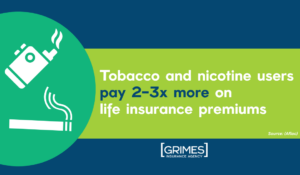
Applicants who use tobacco or nicotine products will often receive a higher premium than applicants who do not. On average, smokers pay 2-3x more on a life insurance policy than a nonsmoker.
If you smoke, vape, chew tobacco, or use another nicotine product, it’s important to provide accurate information when applying for coverage.
Premium Comparison: Nonsmoker vs. Smoker
The following examples use third-party rate data for a $500,000, 20-year term life insurance policy for male applicants.
| Male Nonsmoker Applicant Annual Rate | Male Smoker Applicant Annual Rate | |
| 20-years-old | $210 | $744 |
| 30-years-old | $213 | $795 |
| 40-years-old | $321 | $1,455 |
| 50-years-old | $810 | $3,495 |
| 60-years-old | $2,331 | $8,435 |
| 70-years-old | $9,702 | $13,160 |
These figures are third-party averages based on example rates available in the broader insurance market (Nerdwallet). Actual premiums vary by carrier, state, term coverage length, and amount.
The examples show why tobacco or nicotine use should be considered when estimating what you may pay for term life insurance.
How Much Does Term Life Insurance Cost by Coverage Amount?
The amount of coverage you purchase is another major factor in your premium.
For example, someone purchasing $250,000 in coverage is buying a substantially different death benefit from someone purchasing $500,000 or $1 million.
$250,000 vs. $500,000 vs. $1 Million in Coverage
| Coverage amount | What it generally means |
| $250,000 | Lower death benefit and lower premium |
| $500,000 | More coverage and higher premium |
| $1 million | Significantly more coverage and generally a higher premium |
Increasing your death benefit generally increases your premium, but the price does not necessarily increase in a perfectly proportional way.
Instead of choosing a coverage amount based only on what you think you can afford each month, consider what you want the policy to accomplish.
Ask yourself:
- Would this amount provide enough financial support for my family?
- Would it replace some or all of my or my partner’s income?
- Would it help cover current or future financial obligations?
- Would it provide funds for expenses such as tuition, medical costs, or funeral expenses?
If you’re unsure about how much coverage you need, read How Much Life Insurance Do You Actually Need? to learn about four approaches for calculating an appropriate coverage amount.
How Much Does Term Life Insurance Cost by Term Length?
The length of your policy is another factor that affects what you pay.
Common term lengths include:
- 10 years
- 20 years
- 30 years
For the same applicant and coverage amount, a longer term generally costs more than a shorter term because the insurer is providing coverage for a longer period.
However, that doesn’t necessarily mean you should automatically choose the shortest term. The right term depends on how long you expect to need financial protection.
For example, someone may want coverage long enough to protect their family while their children are dependent, replace income during their working years, or cover a mortgage or other financial obligation.
A shorter policy might be sufficient for some people. However, if your term life policy expires while you still need coverage, obtaining a new policy later may be more expensive
Let’s say you’re a 40-year-old female who has taken out a $250,000 policy for a 10-year term. You start out paying $52 a month for coverage. However, you’ll be 50-years-old by the end of your term, raising your premium to $132 a month if you decide to renew.
When choosing a term length, consider not only what the policy costs today but also how long you actually need the protection.
How Can You Get an Accurate Term Life Insurance Quote?
Online rate estimates can be useful for getting a general idea of what term life insurance might cost. However, an online estimate is not the same as a personalized quote based on your complete underwriting profile.
Insurers may consider information such as:
- Age
- Medical history
- Current health
- Tobacco or nicotine use
- Gender
- Coverage amount
- Policy term
That means two people looking for the same $500,000 policy could receive different premiums.
The most accurate way to understand what you may pay is to have your individual circumstances evaluated by an insurance professional and compare available policy options.
At Grimes Insurance Agency, our team helps clients evaluate life insurance options based on their individual needs and circumstances. If you’re ready to discuss your coverage needs, call our office to connect with an agent. Or, if you’re still weighing your options, read How to Compare Life Insurance Companies to learn what to look for as you search.
Wherever you’re at in the search, we can help you understand your coverage options, compare policies and pricing, and determine what may make sense for your situation.


