

What Happens if You Outlive a Term Life Insurance Policy?
Let’s picture this together.
You bought a 20-year term policy back when you had young kids, a mortgage, and a lot riding on your income. Two decades later, your term is ending right along with that coverage. There’s no payout. No cash value. No automatic continuation. If people still depend on your income, or your family would be left covering final expenses, that expiration date is bigger than just a date on paper. It’s a gap opening up in real time, shrinking your options the longer you wait to deal with it.
If you see yourself in this situation… you aren’t alone.
At Grimes Insurance Agency, we have been helping West Texans navigate life insurance decisions since 1948. We write policies across multiple carriers, so when your term is ending, we can show you real options for your situation so you’re not left figuring it out alone.
In this article, you will learn:
- What a term policy is
- What happens when a term policy expires
- What four options are available (and what they cost)
- How to decide which option fits your situation best.
What is a Term Life Insurance Policy?
A term life insurance policy provides temporary coverage for a specific amount of time. The most common policies are for 10, 20, or 30-year terms. Depending on your personal situation and details, term life insurance premiums are typically lower than those for participating whole life insurance.
What affects term life insurance premiums?
The monthly amount you pay can depend on a variety of factors, such as:
- Your age
- Your gender
- Your health status and history
While it varies, term life insurance is a common purchase for policyholders with young families and children. If you were to pass away while your policy is active, the beneficiary (your spouse, children, etc.) would receive the payout.
If you outlive your term policy is a different story.
What Happens When a Term Life Insurance Policy Expires?
When your term life insurance policy ends, your coverage stops. There is no refund of the premiums you’ve paid, unless you purchased a return-of-premium rider when you bought the policy.
Most insurance carriers will send you a notice before your term ends. If not, it falls on you to keep track of your term policy. When working with a Grimes Insurance agent, we also plan to discuss options when your policy expires. However, it’s important to personally follow your term timeline in addition to these reminders.
If you miss the renewal or conversion deadline, you could lose access to those options completely and be left applying for brand-new coverage with a full medical exam.
The expiration itself isn’t the real risk. The risk is what happens if you do nothing about it.
Four Options When Term Life Insurance Expires
1. Renew the Policy Year to Year
Most term policies let you renew year to year without needing a new medical exam. It sounds easy, but the cost usually makes it hard to stick with it for long. For example, a policy that costs $60 a month at age 40 can jump to $300-$500 a month by age 65. Most people find that increase is unsustainable within a year or two.
Check out these example monthly term-insurance rates from Aflac:
|
Gender |
Age | $125,000 |
$250,000 |
|
Male |
40 | $37.50 |
$70.00 |
| Female | 40 | $28.75 | $52.50 |
| Male | 45 | $55.00 | $105.00 |
| Female | 45 | $43.75 | $82.50 |
| Male | 50 | $80.00 | $155.00 |
| Female | 50 | $68.75 | $132.50 |
| Male | 55 | $118.75 | $232.50 |
| Female | 55 | $90.00 | $175.00 |
| Male | 60 | $175.00 | $345.00 |
|
Female |
60 | $140.00 |
$275.00 |
Disclaimer: The above rates are averaged for a 10-year term life insurance policy for healthy, but average individuals who do not use tobacco products. In addition to other factors, rates can vary by state (Aflac).
Year-to-year renewal works as a short bridge while you sort out a longer-term solution. It can buy you time while you decide what’s next.
When it makes sense: You need a year or two of coverage while you weigh other options.
When it doesn’t make sense: You need coverage for many more years. The rising premiums will likely cost you more than buying a new policy or converting your existing one.
2. Buy a New Term Policy
If your health has not changed significantly, buying a new term policy is often the most cost-effective path. However, keep in mind that life insurance premiums can become more expensive as you age.
For example, a healthy 55-year-old buying a 15-year term with $500,000 in coverage typically pays $150 to $300 per month, compared to $40 to $80 per month for the same coverage at age 35.
The earlier you shop, the better. Your options begin to narrow the closer you get to your current policy’s expiration date.
When it makes sense: Your need for coverage has a clear endpoint, such as paying off your mortgage or retiring.
When it doesn’t make sense: You need lifelong coverage to care for a lifelong dependent, or to leave an inheritance.
3. Convert to a Permanent Life Insurance Policy
Many term policies include the option to convert to a permanent life insurance policy without requiring a new medical exam. Permanent coverage lasts your entire lifetime, rather than expiring after a set term. Whole life insurance is the most common form of permanent coverage, though not the only one. Your conversion window closes either at a certain age or at the end of your term, so it (literally) pays to know your deadline. If you’re unclear about your conversion deadline, review your policy and contact your insurance agent for help. Converting a $500,000 term life policy to whole life at age 55 typically runs $500 to $900 a month.
Do I have to convert my entire term life policy?
Now, it’s important to remember that term life policies are not always convertible. Most policies include conversions in your plan, but you should clarify this with your insurance agent ahead of time. When your policy does offer a conversion period, a common misconception policyholders have is that you don’t have to convert your entire coverage amount to your new policy.
For example, imagine you decide to convert your $250,000 term policy. You have the option of only converting $25,000 of that coverage into a permanent policy, locking in protection that lasts the rest of your life.
Conversion is most valuable when your health has changed, because it lets you keep your original health classification without new underwriting.
When it makes sense: Your health has declined, your conversion window is closing, or you have a lasting need like estate planning or guaranteed final expense coverage.
When it doesn’t make sense: You only need coverage for a limited time (or not at all) and can still qualify for an affordable term policy. Permanent coverage may cost more than you need.
4. Go Without Coverage
Sometimes, you genuinely don’t need life insurance anymore by the time your term ends. If this is the case for you, letting the policy lapse can be a reasonable decision.
However, before foregoing coverage, ask yourself (honestly) whether that’s really your situation. Final expenses alone can run $15,000-$25,000 or more. If that cost were to land on someone else to cover, life insurance may still have a job to do.
When it makes sense: Your obligations are settled, your dependents are self-sufficient, and your estate can absorb final expenses without burdening your family.
When it doesn’t make sense: Someone still depends on your income, carries debt with you, or would struggle to cover your final expenses if you passed away.
| Option | Medical Exam | Cost Trend | Coverage Length | Best For |
| Renew annually | No | Very high | 1 year at a time | Short bridge |
| New term | Usually yes | Moderate | 10-20 years | Healthy applicants |
| Convert | No | High but consistent | Lifetime | Healthy decline/certainty |
| Let expire | N/A | $0 | None | Self-insured families |
What Mistakes Should You Avoid Before Your Term Life Insurance Expires?
Waiting too long to decide or review
Life insurance is a heavy topic, and we completely get it. However, waiting to make that decision can affect your options. We’ve had clients discover they only had weeks left in their conversion window, limiting their time for consideration and next steps.
The conversion window has a hard deadline. Once it closes, you lose the right to convert without a medical exam. If your health has declined, that window may be your only path to affordable permanent coverage.
Grimes Insurance Agency can help you review your life insurance policy. Give us a call to connect with an insurance agent.
Not reviewing the original policy
Conversion rights and renewal provisions are defined in your policy language. Most people have not read it in years. Review it before the term ends to know which options remain and when they expire. One of the biggest mistakes we’ve seen is assuming employer life insurance will continue into retirement.
For example, someone with a $1 million life insurance policy through their job might assume it’s something they’ll have forever. However, once they retire, their coverage disappears right along with the job. By that point, their health condition has changed and possibly taken a turn, and no insurance company will offer them a new policy at any price– they’ve become too big a risk.
Reviewing your policy with an agent beforehand is helpful in more ways than just saving money. Those conversations can help you determine if you still need coverage and find the kind that suits you best.
Underestimating cost at an older age
Most policyholders assume they’ll simply renew at the same premium. However, a 20-year term bought at 35 and a 20-year term bought at 55 are priced very differently. Getting a quote before your current policy expires gives you a real picture of what a new policy will actually cost you.
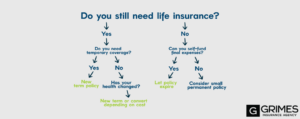
How Can Grimes Insurance Help When Your Term Life Insurance Expires?
Outliving your term life insurance policy doesn’t mean you’re out of options, but waiting too long to decide can limit them.
Going without coverage when people depend on you, or missing your conversion window because you waited too long, can leave your family exposed to costs they were never prepared to absorb. That outcome is avoidable, but only if you act before the deadline hits.
If you’re still deciding whether term or permanent life insurance is the better fit, your next step is learning how Term vs. Life Insurance compare. Watch this video to understand the differences between term and whole life insurance and how you can find the option that best fits your long-term needs:
At Grimes Insurance Agency, we don’t wait until your deadline is about to pass. If you’re approaching year 18 or 19 of your 20-year policy, we’ll work with you to figure out your next steps. We’ll help you review your current coverage, explain your available options, compare them across multiple providers, and help you decide before your policy expires.
Frequently Asked Questions
Do I get any money back when my term life policy expires?
Not unless you purchased a return-of-premium rider when the policy was written. Standard term policies do not return premiums if you outlive the term.
Can I still get life insurance after my term expires if my health has declined?
Possibly. Guaranteed issue and simplified issue policies are available without a full medical exam, but they carry higher premiums and lower coverage limits.
How long do I have to convert my term policy to permanent coverage?
The conversion window varies by policy. Some allow conversion up to a certain age, others only during the original term. Review your policy documents or call your agent to confirm.
Is permanent life insurance worth it at my age?
If you have a permanent need, such as final expenses, estate planning, or leaving a guaranteed death benefit, permanent coverage may be the right tool. If your need has a defined endpoint, a new term policy is likely more cost-effective.
What is the difference between whole life and universal life?
Both are permanent policies that do not expire and build cash value. Whole life has fixed premiums and a guaranteed cash value growth rate. Universal life offers more flexibility in premiums and death benefit amounts, but with less predictability in cash value growth.
Disclaimer: The information provided in this article is for general informational purposes only and does not constitute legal, financial, or insurance advice. Coverage options, terms, and availability may vary. Please consult with a licensed professional for advice specific to your situation.


