
How Does Grimes Compare Insurance Options?
By: Hayley Rodriguez, Personal Lines – Sales Executive
Let’s face it. Comparing insurance quotes is not an easy feat. Between the policy language, similar pricing, and an endless number of options, it’s enough to go cross-eyed.
Choosing a policy involves more than price; it also involves finding the right kind and amount of coverage. But how do you look for both? What starts as a simple search can easily become a spiral of questions and confusion.
Working with a diverse network of 100+ insurance carriers, Grimes Insurance understands the struggle. For over 78 years, we have helped West Texans take the guesswork out and find the best coverage for them and their families!
By the end of this article, you will understand what our carrier comparison process looks like, including:
- What we look for when comparing
- How we narrow your insurance options
- How our comparison helps you find the right coverage
How does Grimes compare insurance options?
Grimes Insurance follows a process that starts with a broad group of carriers and gradually narrows the options based on your specific situation. Let’s break it down.
Step 1: Grimes gets initial quotes from multiple insurance carriers
Once an agent receives your quote form, Grimes uses rating software to pull initial quotes across our network of carriers all at once.
This step is all about scouting out your options and seeing what’s available. The initial quotes give your Grimes agent a starting point for determining which carriers are worth looking at more closely.
How does Grimes shop across carriers?
Grimes Insurance is an independent insurance agency. Unlike a captive insurance agent who works for a specific insurance company (like Progressive, GEICO, or Nationwide), our agents have the ability to shop with multiple carriers at once.
How does that work? Let us explain:
| Independent insurance agent | Captive insurance agent |
|
|
Independent agents aren’t better than captive agents, or vice versa. However, independent agents can help you search more policy options at once. Deciding which type of agent you work with boils down to the options you need.
Still curious about the difference? Read How Do Independent Insurance Agencies Work? to learn how independent and captive agents compare in the search for insurance.
Step 2: Grimes matches carriers to your specific situation and information
Once the initial quotes are available, the next question is: which of these carriers actually makes sense for you?
Insurance is all about making it personal AND specific. We know that coverage isn’t one-size-fits-all, which is why we take the time to consider all factors that can affect your situation.
What information is important for comparing insurance options?
Depending on what you’re looking to insure, the information your agent will need from you can vary. Building out an insurance quote involves both information about what you’re insuring (your home, vehicle, etc.) and personal information specific to you.
Some of these details include:
| Personal information | Home details | Auto details |
| Full name | Roof age and condition | Annual mileage |
| Date of birth | House and construction type | Accident history |
| Gender | Square footage | Driver training and history |
| Marital status | Property address | Vehicle identification number |
| Basic contact information | Occupancy details | Vehicle make, model, and year |
| Driver’s license number | Recent renovations or updates | Primary vehicle use |
Prior to this step in the process, you will have already shared these details with your agent or included them when you requested a quote.
Keep in mind that at this stage, reports may not have been fully run, and some details may still need to be verified. Because of that, the initial premium isn’t necessarily what you’ll ultimately pay.
Once your information is confirmed, the price can change by hundreds or even thousands of dollars.
Still curious about what your personal information can say about you and your policy? Read Grimes’ Approach to Personalized Insurance to learn how certain details help determine your coverage options.
The goal is to identify carriers that are actually a fit—not just carriers that happen to return a low number.
Step 3: Grimes narrows the options and fully works the strongest carriers
After the initial comparison and applied information, your list of carriers begins to narrow down. Typically, the broad list of carrier options becomes a smaller list of three companies your agent finds worth considering.
This is where the process goes beyond simply looking at prices.
Your Grimes agent fully builds out the strongest options using your verified information so the coverage, price, and carrier fit can be compared more accurately.
That means looking at more than the premium. Our agents consider policy details such as:
- Coverage limits and exclusions
- Deductibles
- Available coverage endorsements
- Available discounts
- Policy and carrier requirements
- Rating information
- Underwriting guidelines
We become coverage detectives, if you will.
This part of the process matters because two policies can have very different coverage… even if their premiums look similar.
A Tale of Two Policies: An Example of Insuring an Older Home
Let’s say you’re purchasing a 1970s home and looking to insure it. You receive two online quotes: Policy A and Policy B. However, their premium amounts are nearly identical, and you’re stumped on deciding.
However, as you compare further, you realize only Policy A offers hidden water coverage, which is a major endorsement to have for an older home. (Nice catch!)
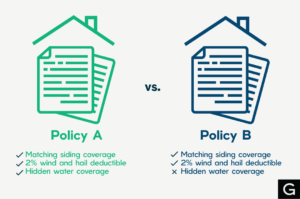
Unfortunately, not all homeowners make the same catch before deciding on the wrong policy. Working with a Grimes agent to spot those coverage gaps for you can make all the difference.
A real comparison means comparing policies that are built around comparable coverage, not simply comparing how much they’ll cost. From the strongest three options, one quote is fully built out as the recommendation your agent will present you with.
Step 4: Grimes accounts for underwriting and keeps a backup option
Even after a quote has been fully worked, the process isn’t necessarily over.
What is underwriting?
Underwriting is the process insurers use to evaluate your personal risk, determining whether your property, vehicle, business, or item meets their guidelines. This process is happening behind the scenes and can change the picture of your policy.
This review might uncover missing documentation, property issues, or other information that wasn’t reflected in the initial quote.
Sometimes, underwriting might come back the night before closing on a home policy asking for additional documentation. In some cases, the carrier may decline to write the property altogether.
That’s exactly why Grimes Insurance agents keep a backup option available, even after the search.
If the first choice falls through, there’s already another viable option instead of starting the insurance shopping process again under time pressure.
Step 5: Grimes presents you with options
The time has come, and it’s time for you to choose! But don’t worry, we’re still here to help you.
What does Grimes actually hand you after comparing insurance options?
Rest assured, you won’t be left with a pile of numbers to interpret on your own.
Your Grimes agent will give you a fully worked recommendation based on your specific situation, explain why that option was selected, and keep a backup option on hand if needed.
Our goal isn’t to overwhelm you with choices. It’s to do the comparison work for you and explain why the recommended policy makes sense.
If at any point you’re unsure or want to consider different options, your agent is prepared to help you break down your coverage and go back to the drawing board.
What does a real insurance comparison look like?
One family came to Grimes after their existing insurer gave them eight days to complete a long list of repairs– or they’d risk losing their homeowners’ coverage.
They weren’t just shopping for a lower price, but looking for someone who would be straightforward with them about what was actually going on with their property.
Rather than simply quoting another carrier, their new agent looked more closely at the issues identified by the existing insurer. Two in particular:
- Removing a tree with overhanging limbs
- Resolving an in-progress renovation to their home
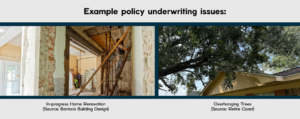
Their Grimes agent verified the issues and connected the family directly with a contractor who could address them.
In the end, the policy that ultimately worked increased their premium by roughly $600 across home and auto. Yet, they chose it anyway.
“But now they’re paying more! Why would they choose that option?”
Because Grimes Insurance helped them understand exactly what they were getting, why the policy cost more, and why it made sense for their situation.
That’s what a meaningful insurance comparison should provide: clarity about what you’re paying for, not just a list of numbers.
How does Grimes make the insurance comparison easier?
There’s more to comparing insurance than collecting prices and making guesses. It’s about determining which policy and carrier make sense for you and explaining that recommendation clearly.
Grimes Insurance starts with a broad group of carriers, verifies the information, narrows the options, and presents you with a recommendation that makes sense for you. It’s all part of the process to find you the best fit for coverage.
If you have questions about how carrier comparison fits into requesting a quote, read about the Insurance Quote Process at Grimes Insurance Agency and learn what else you can expect. And when you’re ready to compare your current coverage with other options, request an online quote. Since 1948, Grimes Insurance has been ready to help you understand the differences and determine what makes sense for your home, vehicles, and situation.
Frequently Asked Questions
How many insurance carriers does Grimes compare?
Grimes initially pulls quotes from roughly a dozen-plus carriers, then typically narrows those options to about three carriers worth fully working based on your specific situation.
Why can my insurance quote change after I submit my information?
Initial quotes may be based on information that hasn’t been fully verified. Once reports, property details, claims history, or other information are reviewed, the premium or carrier eligibility can change.
Why doesn’t Grimes just recommend the cheapest insurance quote?
Because the lowest premium doesn’t necessarily represent the same coverage or the best carrier fit. Grimes considers the policy, coverage, property, vehicles, carrier requirements, and underwriting in addition to price.
Why does Grimes keep a backup insurance option?
Underwriting can change the outcome even after a quote has been fully worked. Keeping a backup option available means there’s another viable path if the primary carrier requests something unexpected or ultimately declines the property.


