
How Much Dwelling Coverage Do You Need in Lubbock?
By: Niki Saavedra, Director of Operations
Executive Summary:
Your home’s dwelling coverage should match your home’s replacement (or rebuild) value. In Lubbock and West Texas, local construction costs can run roughly $145 to $250 per square foot. But your actual replacement cost depends on your home’s size, construction quality, materials, features, labor costs, and other property-specific factors.
The most reliable way to determine whether your dwelling coverage is sufficient is to review a replacement cost estimate and compare it with your current policy limit.
If your home were destroyed tomorrow, would your insurance coverage be enough to rebuild it?
Construction costs, labor, and materials change over time, meaning the number on your policy could be below what it would cost to rebuild your home today. If you’re underinsured, you could be left paying the difference out of pocket.
At Grimes Insurance Agency, we’ve helped West Texas homeowners evaluate their insurance coverage since 1948. Our experience working with homeowners in the area has shown us why it’s important to review dwelling coverage as construction costs and homes themselves change over time.
In this article, we’ll explain:
- What dwelling coverage includes
- How to estimate the amount you need
- What can happen if you’re underinsured
- Which factors West Texas homeowners should consider when reviewing their policies
What is Dwelling Coverage in Home Insurance?
Dwelling coverage (also known as Coverage A) is the portion of your homeowners insurance policy that pays to repair or rebuild your home’s physical structure after a covered loss.
It generally covers items such as your home’s:
- Walls
- Roof
- Foundation
- Permanently attached systems (Electrical, plumbing, and HVAC)
Depending on your policy, covered causes of loss may include fire, hail, windstorm, and vandalism. Coverage depends on the specific policy, including its covered causes of loss, exclusions, deductibles, and endorsements.
It does not generally cover your land, personal belongings, or detached structures (aka, a shed or garage), which may fall under other parts of your homeowners policy.

One of the biggest misconceptions we see clients have is using market value to determine their dwelling coverage. However, your dwelling coverage should actually reflect what it would cost to rebuild your home’s structure, not what it would sell for.
What is the difference between market value and replacement cost?
Market value and replacement cost are two completely different numbers.
- Market value reflects what someone would pay for your home.
- Replacement cost (or rebuild cost) reflects how much it would cost to reconstruct your home after a total loss, based on current labor and material costs.
For example, a home might have a market value of $300,000 but cost $400,000 to rebuild. In that scenario, insuring the home based on its market value could leave a $100,000 gap between the dwelling coverage limit and the estimated reconstruction cost.
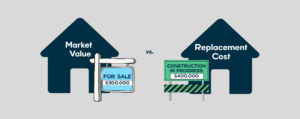
Keep in mind that your actual replacement cost depends on your home’s characteristics and local construction prices. How much you purchased, or how much you can sell your house for, is not a reliable substitute for a replacement cost estimate.
How do you calculate the right dwelling coverage amount?
Dwelling cost should be based on your replacement or rebuild value, so your starting point should be finding that estimate. Estimates vary based on construction companies, carriers, and your home details. However, there are a handful of ways to help you understand what your home may cost to rebuild.
1. Use square footage for a rough rebuilding estimate
You can multiply your home’s square footage by a local construction-cost-per-square-foot figure to get a preliminary idea of what rebuilding could cost.
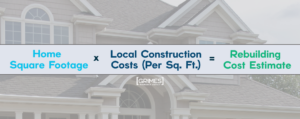
In the Lubbock and West Texas market, custom construction costs have been estimated at $145 to $240 per square foot for the structure, excluding land. Higher-end construction with premium finishes and features can cost more.
Using that range, a 2,000-square-foot home could have a rough construction-cost range of $290,000 to $480,000.
| $145 per sq. ft. | $240 per sq. ft. | |
| 1,500 sq. ft. home | $217,500 | $360,000 |
| 2,000 sq. ft. home | $290,000 | $480,000 |
| 2,500 sq. ft. home | $362,500 | $600,000 |
** These figures are rough examples based on just one set of published ranges. They are not personalized replacement cost estimates or guaranteed reconstruction prices.
Actual costs can vary significantly based on labor availability, material prices, your home’s architecture, features, debris removal, site conditions, and the specific characteristics of your home.
When estimating, you should use the square-foot calculation as a preliminary check, not as the final number your insurance policy should use.
If you’re unsure of how much local construction costs are in your area, contact your real estate agent or the West Texas Home Builders Association to be pointed in the right direction.
2. Ask your insurance agent to run a replacement cost estimate
A replacement cost estimate uses information about your home to estimate how much it would cost to rebuild the structure. Insurance carriers may use replacement-cost estimating tools as part of determining an appropriate dwelling coverage limit.
Depending on the estimator, information required by the carrier may include:
- Your home’s square footage
- Number of stories
- Type and quality of construction
- Roof materials and features
- Interior finishes, cabinetry, and flooring
- The age and characteristics of the home
- Local labor and material costs
Two homes with the same square footage can have very different replacement costs. A home with custom cabinetry, specialty windows, and high-end finishes, for example, could cost more to rebuild than a home with standard finishes of the same size.
3. Account for inflation and changes in construction costs
Even if your dwelling coverage and replacement costs were accurate when you purchased your policy, it may no longer reflect current rebuilding costs.
Labor rates, building materials, and contractor availability can change over time. A coverage limit that made sense several years ago may not be sufficient when you need to rebuild today.
An inflation guard is a policy feature that keeps carriers from increasing the dwelling over a certain amount. For many of our client policies, a 3% guard is the most common. It can help your coverage keep pace with rising costs, but it does not guarantee that your limit will match actual reconstruction expenses.
If your carrier does not offer an inflation guard as part of a policy, you may be able to add one to your home’s coverage as an endorsement.
Unsure how to do that? Grimes Insurance can help you explore available endorsements and determine which ones might make sense for your situation. Contact our office to connect with an agent to discuss your policy’s possibilities.
The best way to stay ahead of changing construction costs is to review your coverage at renewal and after major changes to your home.
What happens if your dwelling coverage is too low?
If your dwelling coverage is insufficient, your policy is leaving you underinsured. That can leave you with a financial gap if a covered loss costs more to rebuild than your policy limit or applicable coverage provisions provide.
For example, if your home would cost $400,000 to rebuild but your policy provides only $300,000 in applicable dwelling coverage, you could be responsible for the remaining $100,000.
What is coinsurance?
Some policies include an insurance-to-value (also known as coinsurance) provision that can reduce a claim payment when your coverage falls below the amount required by the policy.
For example, if your home would cost $400,000 to rebuild, but you only carry $240,000 in coverage, you could face a significant coverage shortfall, depending on the terms of your policy.
The takeaway? Your dwelling limit should be reviewed against your home’s current estimated replacement cost, not an outdated estimate or its market value.
You should plan to reevaluate your coverage regularly as your home ages, construction costs change, or your property is updated.
What Should West Texas Homeowners Consider When Choosing Dwelling Coverage?
If you live in Lubbock or the South Plains, you already know that West Texas homeowners face specific weather and construction considerations.
Your dwelling coverage should account for your home’s estimated replacement cost, while your policy’s covered perils, deductibles, exclusions, and endorsements determine how a covered loss may be handled.
How do hail and wind affect your dwelling coverage needs?
With nearly 3 to 5 hail events a year, hail and wind can damage multiple parts of your home at once, including the roof, siding, gutters, windows, and HVAC equipment.
Your dwelling limit should reflect the estimated cost to rebuild, while your policy’s covered perils, deductibles, and exclusions determine how a storm loss is handled.
We recommend reviewing both your dwelling limit and wind and hail deductibles to understand your potential out-of-pocket costs.
How often should you review your dwelling coverage?
We recommend clients review their dwelling coverage at every policy renewal and after significant home improvements.
A review is particularly important if:
- You haven’t updated your replacement cost estimate in several years
- You’ve remodeled spaces in your home
- You’ve expanded your home’s square footage
- You’ve upgraded your roof, windows, flooring, or other major features
- You’re unsure about inflation protection or additional replacement cost coverage
The goal is to identify potential coverage gaps before a loss occurs, rather than discovering them after you need to rebuild.
During this time, we recommend leaning on your insurance agents to help answer any questions or confusion you have about your homeowners policy.
How can Grimes Insurance Agency help you review your dwelling coverage?
The right dwelling coverage is based on what it would cost to rebuild your home today. Your market value, purchase price, and existing mortgage balance won’t necessarily tell you whether your insurance limit is sufficient.
A replacement cost estimate, a review of your policy’s coverage endorsements, and a discussion of your deductible with an agent can help you understand your financial exposure before a loss occurs.
At Grimes Insurance Agency, we’ve helped West Texas homeowners evaluate their insurance needs since 1948. We understand that choosing a dwelling coverage limit involves more than selecting a number and moving on.
We take into consideration your home’s characteristics, estimated replacement cost, current limits, and relevant policy provisions. We also represent multiple insurance carriers, allowing us to discuss available coverage options and compare which policies make sense for your needs.
If you haven’t reviewed your dwelling coverage recently, contact our office to review your policy with an agent. Or, if you’re not quite ready for a review, read What to Expect When Shopping for Home Insurance with Grimes to learn about how the rest of your homeowners policy fits together, and how the agency’s process works.
Frequently Asked Questions
Is dwelling coverage based on the purchase price of my home?
No. Dwelling coverage should generally reflect the estimated cost to rebuild the home’s structure at current prices. Your purchase price includes factors such as land value and market demand that don’t directly determine reconstruction cost.
How do I know if I have enough dwelling coverage?
Ask your insurance agent to run a replacement cost estimate based on your home’s actual features and current local construction costs. Compare that estimate with your dwelling coverage limit, and review whether your policy includes additional replacement cost benefits or insurance-to-value requirements.
How often should I update my dwelling coverage?
Review your coverage at every renewal and after significant renovations or additions. Changes in construction costs can also make an updated estimate worthwhile, even if you haven’t made changes to the property.
Does homeowners insurance cover the full cost of rebuilding?
Not necessarily. Your policy’s dwelling limit, covered causes of loss, deductibles, exclusions, and any additional replacement cost provisions affect how much the insurer will pay. Review your policy to understand whether additional coverage is available if reconstruction costs exceed your stated limit.
Does dwelling coverage include my garage or shed?
An attached garage may be included as part of your dwelling, while a detached garage or shed is generally covered under a separate other-structures provision. Check your policy to confirm how your specific structures are insured.


