
How Much Does Contractor Insurance Cost?
If you’re trying to budget for contractor insurance, you’ve probably searched online, hoping to find an average price. Instead, you’ve likely found dozens of articles saying, “Well… it depends.”
While that’s technically true, it isn’t very helpful. And we want to give you the tools to actually answer that question.
For the past 78 years, Grimes Insurance Agency has worked with contractors across all trades and helped them understand why their insurance costs what it does. Whether you’re a plumber, electrician, HVAC, or general contractor, it’s important to realize that your insurance premiums aren’t guesswork.
In this article, we’ll explain the biggest factors that affect contractor insurance costs, why your premium changes as your business grows, and the biggest opportunity you have to lower what you pay over time.
What Determines Contractor Insurance Rates?
Every commercial insurance policy starts with a rating factor. Depending on the policy, insurers calculate premiums using one of three measurements:
- Gross sales: how much money your business brings in before expenses
- Gross payroll: how much money you pay your employees (before taxes)
- Square footage: the size of your building or property
Which factor applies is based on the type of business and policy being insured.
| Rating Factor | Used For | Why |
| Gross Sales | General contractors | More sales usually mean more customers and greater exposure |
| Gross Payroll | Trade contractors (plumbing, HVAC, electrical) | Risk comes from greater hands-on labor |
| Square Footage | Property or holding company with no sales or payroll | Used more often for leasing property |
For most contractors, the primary rating factor is either gross sales or payroll. A company that owns a commercial building but doesn’t actively operate a business there may instead be rated by square footage.
Once the insurance company determines which rating method applies, every contractor within that classification starts with the same base rate. The difference isn’t the rate itself, but how much exposure your business has.
How is Contractor Insurance Calculated?
Let’s work through an example together.
Imagine you’re a general contractor with general liability insurance. Your insurance provider’s current rate is $3.50 per $1,000 of your business’s gross sales.
Your business is generating $1 million in annual revenue, causing you to pay roughly $3,500 in premiums before any additional adjustments.
The general contractor down the street is making $10 million in annual revenue. Their premium, on the other hand, is roughly $35,000.
Both you and the other contractor are paying the same rate. The larger contractor simply pays more because they’re completing more work, serving more customers, and taking on more opportunities for a claim.
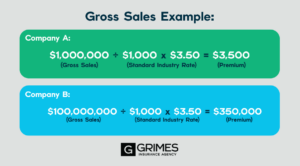
This same concept applies to whether your policy is based on sales, payroll, or another exposure measurement.
What Factors Affect Contractor Insurance Costs?
While your payroll or sales are usually the starting point, they aren’t the only things insurers consider.
The Trades You Perform
Not all contracting work carries the same level of risk.
An HVAC contractor has different exposures than an electrician. A plumber has different risks than a roofer. According to USA Business Insurance’s latest review, roofing contractors are considered one of the riskiest trades to insure for general liability.
If your company performs multiple trades, such as plumbing, HVAC, and electrical, each classification may be rated separately before being combined into one premium. Even within the same trade, residential and commercial work often have different rates because not all risks are identical.
It all depends on the risk your trade poses to you, your employees, and those you’re doing the work for.
The Size of Your Business
As your company grows, your insurance premiums usually grow with it. The more employees, projects, equipment, and job sites, the more opportunities for accidents and claims.
Growth is a good thing, but your insurance policy must keep up with your business. Curious about how to avoid claims denials with a growing business? Read about the 3 Most Common Reasons for Commercial Claim Denials to protect your company from possible coverage gaps.
Your Claims History
Insurance companies also look at how often you’ve had claims in the past. A business with a long history of accidents or lawsuits generally represents more risk than one with a strong safety record.
This doesn’t necessarily mean one claim will drastically change your premium costs. However, consistently preventing accidents over time can have a meaningful impact on what you pay.
Why Do Contractor Insurance Premiums Change During the Year?
One of the biggest pricing surprises for contractors happens during the annual insurance audit. But there’s no reason to panic! This is a normal, yearly process for businesses.
When your policy begins, you’re estimating what your payroll or sales will be for the coming year. For example purposes, let’s say you estimate your payroll at $500,000.
Six months later, business is booming, you’ve hired several employees, and you’re now on pace to finish the year at $800,000 (pat yourself on the back!)
Because your premium was originally calculated using the lower payroll estimate, your insurance company will settle the difference during your annual audit. That often results in an additional premium due at the end of the policy period.
We recommend staying in contact with your insurance agent throughout the year. As things change within your business, make them known to your agent. Updating your payroll or adding new operations as your business changes can spread those costs over time, rather than surprising you with a single large bill.
Have you made any recent changes to your business? Contact Grimes Insurance Agency to speak with an agent about amending your commercial coverage.
How Can You Lower My Contractor Insurance Costs?
While most pricing factors aren’t things you can control, being proactive about your business’s claims and coverage changes is one of the most helpful options.
Another option that can dramatically affect your workers’ compensation costs over time is your experience modification factor.
What is an Experience Modification Factor (EMOD)?
In simple terms, it’s a value that shows how your business compares to others within the industry based on your workplace losses (aka: claims, employee injuries, etc.)
Every contractor begins with a standard experience modifier (EMOD) of 1.0. Once your business has enough insurance history, your modifier is calculated using your previous three years of workers’ compensation claims (excluding the most recent policy year).
A higher EMOD increases your premium. A lower EMOD decreases it.

For example, a contractor with a 1.4 EMOD will pay 60% more on their premiums than a contractor with a 0.8 EMOD. For larger contractors, that difference can save (or cost) tens of thousands of dollars each year.
The best way to keep your EMOD below 1.0 is to emphasize safety across your business. This can look like:
- Report injuries early
- Observe employee behaviors and safe practices
- Regularly train employees
- Investigate accidents to make preventative changes
Dive deeper into what an EMOD is and how it affects your business in this video:
How Grimes Insurance Helps Contractors Find the Right Insurance Rate
While there is no universal price, understanding how contractor insurance is priced is the first step toward budgeting accurately. The only way to know what your business will actually pay is to evaluate your specific operations, payroll, sales, and coverages.
Interested in getting a quote for your business? Grimes Insurance Agency has a dedicated commercial lines team prepared to walk you through your contractor’s insurance policy. Call our office to explore your insurance premiums and find the right coverage for your business.


